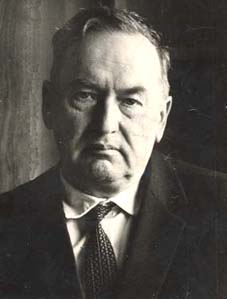
Rudnev Dmitriy Fyodorovich was born on June, 8, 1902 in the town Korsun, Kiev Region (Russia). He began labor activity at the Civil war as a workman in a railway workshop, in particular he worked as a smith. At the beginning of 1920-ies, he entered Leningrad Forest and Technical Academy with specialization on forestry. A student's practice he spent in Ukraine in the native land.
Here, it began his scientific activity as a practicing student at the Darnitsa Forest Research Station. This Station was found by Z.S. Golovyanko in village Bortnichi near by Kyiv. The founder was successful in organization of the staff of scientists, who became prominent specialists in the branch of forest entomology - A.I.Il'insky, N.C.Greze, V.L.Tsiopkalo, V.Yu.Parkhomenko, and M.O.Anfinnikov. The scientific level of this station was considered, as that equals an institute. The student joined to this staff, and brought a significant contribution in solving of the problem of population dynamics of bark beetles and their biology.
In that time, an outbreak of bark beetles was one of the main problems of forest protection. It arose in a result of heavy drought in 1921 and decline of public life, which dominated in Ukraine during the Civil war and several years after that. D.F. Rudned took part in the studies, which gave important results.
The group of scholars under guidance of Z.S. Golovyanko with participation of A.I. Il'insky, D.F. Rudnev N.C. Greze, V.L. Tsiopkalo, V.Yu. Parkhomenko and M.O. Anfinnikov revealed regularities of population dynamics of bark beetles in the context of physiological state of host trees.
It was stated that healthy trees cannot be colonized by bark beetles if amount of their populations had not increased comparing with that presenting in undisturbed forest. Contrary, at weakening physiological state of trees due to drought, forest fire or other stressors, bark beetles colonized host-trees succesfully. Then, because their food resource became abundant, the brood developed in the conditions of low density. Therefore, an amount ot their populations increased greatly. Being numerous, bark beetles are able to attack healthy trees and successfully colonize them.
Although such a colonization result in a decrease of bark beetle populations due to food stuff deficiency for the brood in the conditions of high density. This process leads to the decline of forest.
To counteract the decline, it needs to keep physiological state of trees on the high level by means of proper silvicultural practices. The practices allow to maintain health of forest even at such common stressor as drought. At appearing of heavy weakened or colonized by bark beetles trees, it is necessary to apply sanitary measures in forest as soon as possible. These recommendations are true until now and will be true for ever.
In addition, being a practicing student, D.F. Rudnev conducted the fundamental study of biology of bark beetles.
In 1926, D.F. Rudnev completed Leningrad Forest and Technical Academy. After that, he went to work in Institute of Zoology of Academy of Science of Ukraine, where he worked up to 1936.
This period his activity is characterized by studies of causes of decline of the Black Forest oak stands (the Kirovograd Region, Ukraine). In this forest massif, it took place an outbreak of the large oak longhorned beetle, Cerambyx cerdo L. D.F. Rudnev stated that this outbreak was a result of the wrong method of main cutting of the forest that resulted in weakening of the trees on borders with clear-cut areas. These trees, which had been growing in the state of closed stands, suddenly occurred exposed to sunlight in a result of the cutting. These events were ruinous for physiological state of the trees, so that the longhorned beetles colonized them successfully. D.F. Rudnev proposed the change the method of the main cutting that led to bettering of the situation.
In 1930-ies, D.F. Rudnev proceeded to the main work in his scientific activity - the study of an effect of physiological state of host trees on insect herbivores. On the example of the gypsy moth, he showed that at feeding of the caterpillars on a set of host-trees, fecundity of the butterflies depended on adaptation of this species to feed on species in previous generations. Importantly, mortality of the larvae due to feeding by inadequate food took place mainly in their young stages. This effect was called "children's mortality." The older larvae were able to feed by leaves of non-host species rather safely. These conclusions were initial steps in cognition of effect of host-tree physiology on insect defoliators.
In 1936, D.F. Rudnev shored the destiny of numberless citizens of Soviet Union. He was convicted on deportation in the Magadan Region (the Northeast Siberia) for eight years as a prisoner - an enemy of the Soviet Power. The Power needs in slaves for building of socialism. As a ground for the conviction, it served an abroad publication of the scientific paper in the journal Zeitschrift fur angewandte Entomologie, 1935, B.22., Heft 1, S. 61-96. This was republication of the paper about the longhorned beetle published in Soviet Union.
In the Siberia, D.F. Rudnev conducted hard works on wood-cutting operations. At fierce Siberian frost, he got frost-bitted feet, so that it had to amputate fingers on both feet. Two times he beside with other members of the team of prisoners were sentenced to be shot for an unfulfilled task of work. Fortunately, in the both cases, the prisoners had success in proof that a fail in the task of work was not due to their fault.
Even in inhuman conditions of the Gulag, D.F.Rudnev did not cease scientific activity. Working on wood cutting, he studied fauna and biology of bark beetles. He got a job at a meteorological station, where collected data about weather conditions in the Magadan Region. After returning from the deportation, he published the paper "Bark beetles of Magadan Region" in the journal "Entomologicheskoe obozrenie" (Entomological Review). In this paper, it was shown weather situation that allowed to reveal peculiarities of fauna and life history of bark beetles in very severe environmental conditions. Similar studies are unknown until now. The paper was republished abroad (in Israel) that was a sign of recognition of a selfless of this scientific labor.
This activity in the detention is a monument of high spirit of a scholar, who strives to know Nature being between life and death. D.F. Rudnev was a devotee of science entire his life. He worked with his manuscripts until he can keep a pen in his hands.
D.F. Rudnev, however, was a successful man. He escaped the worst destiny. Here are the circumstances of his returning from the imprisonment. It stayed fall of 1943, when the term of his imprisonment finished. The last in that navigation ship had been preparing to depart on "Great land", i.e. to Vladivostok. Although D.F. Rudnev did not find his name in a list of passangers of this ship. He rushed to the commissar, who commanded by the dispatch of the prisoners. The commissar promised him to look into this problem, closed D.F. Rudnev in his office, and went out. At that time, the ship sailed. After some time, it coneyed news that the ship sunk, but her command saved itself. This was the way, by which the Soviet secret police (NKVD) killed "enemies of the people." The warders did not grudge even the ship in spite of the war time. Fortunately, D.F. Rudnev was regarded as a harmless person, so that his life was saved. He told about this horror to his friend V.L. Tsiopkalo. The latter told it to M.O. Anfinnikov. And the latter told it to G.I. Vasechko.
The sister of D.F. Rudnev - Drobnitskaya Olga Fyodorovna was captured by NKVD and disappeared in Gulag. Her daughter said that the mother was a beautiful and proud woman. The daugther supposed that her mother was killed, because she spurned sexual solitition of the wire-camp administration. The husband of O.F. Drobnitskaya also was arrested by NKVD and perished.
In 1944, D.F. Rudnev returned to Kyiv. He did not find his wife. People sayed that she was took out by German occupationists, when they left Kyiv. He had to begin life on a blank space. He did not give himself up. He found salvation in an active labor.
At one time, he worked as an engeneer of forest protection at Kyiv Deparment of Silviculture. Beginning with 1946, he worked in the newly organized Institute of Entomology and Phytopathology of Academy of Science of Ukraine, which in 1956 was renamed in Ukrainian Institute of Plant Protection. Now this is Institute of Plant Protection of Ukrainian Academy of Agrarian Sciences. In this Institute, D.F. Rudnev worked until retiring on a pension.
Already in 1946, he maintained the thesis of Candidate of Science (Biology). In 1953, D.F. Rudnev maintained the thesis of Doctor of Science (Biology). In 1959, it was awarded by the rank of Professor.
In the initial years after the World War II, D.F. Rudnev took part actively in development of the most prospective in that time the method of plant protection against pest organisms - application of pesticides. He developed measures of control pest insects of diverse groups - root-eating on the pine, in particular grubs of the cockchafer, defoliators of deciduous and coniferous trees, and stem borers. In so doing, it was proposed recommendations as to concrete preparations and rates of application. He was one of the first scholars who developed of the method of low-volume spraying of plants by insecticides. This method allowed increasing of economy of protection of field, and orchard crops, as well as forest stands. He brought an important contribution in protection of timber against stem borers. Such recommendations were used for abolishment of consequences of the large windthrow in the Carpathians Mountains.
Having a prestige of one of the most competent specialist in the field of chemical method of plant protection in Soviet Union, D.F. Rudnev was the first scholar, who understood the disadvantages of ungrounded application of pesticides. In last decades, the danger for human health and state of the environment, which arose in the context of pesticides, was recognized widely over the World.
Nevertheless, just D.F. Rudnev was a pioneer, who put forward this problem, and began to agitate actively for development of alternative of this method by means cultivation of the plant resistant to pest organisms.
Abroad, wide movement against the groundless application of pesticides began after the book by R. Carson "Silent spring" had appeared in 1962. Notably, that D.F. Rudnev put this question as early as in 1957, when he addressed to staff of the laboratory, which was headed by him, with the motto: we worked on the chemical method of plant protection pretty, it is time to search for other ways of solving this problem.
He posed the task to the laboratory's staff to develop the method based on enhancing of host-plant resistance to their pest organisms. The core of this method consists in ensuring of a lack of the damage by means of increasing of their natural self-protection against pest organisms.
He posed the task to the staff to develop the method based on enhance of host-plant resistance to their pest insects.The plant resistance is provided by both hereditary and physilogical factors. Therefore, the plants with heredity adapted to human usage should be provided by genes of the resistance. The traits of resistance operate on condition that physiological state of these plants is proper. This state is provided by appropriate level of cultural practices. In wild plants, natural resistance to pest insects is well developed. If they grow in the conditions providing proper physiological state, such plants are able to protect themselves against pest insects.
Such an approach to solving of plant protection problems promises optimization of interrelations of mankind and nature that results to a decrease of danger on the part of pollution of the environment and a decrease of expenditures on plant protection.
The program of D.F. Rudnev, which he brought up to his collaborators, consisted of two ways, namely: study of factors of plant resistance to plant pests, and development of measures to enhance this resistance. Knowledge of the factors points out on the physiological or morphological traits, which should be expressed better by breeding, whereas proper cultural practices effect positively on physiological state of plants that determines good development of protective traits providing self-protection of the plants.
The staff of collaborators under the guidance of D.F. Rudnev brought important contribution in solving of the above problems. Íå with his disciples ascertained the factors of host plant resistance in the spruce to bark beetles, in the oak to the gypsy moth, in the pines to the pine shoot moths and the flat bark bug, in the potato to the Colorado potato beetle, in the soy bean, the clover and the winter wheat to complexes of pest insects. It was developed and recommented to practice a number of propositions, as follows:
1. The system of measures for establishing of oak stands with complex resistance to pest insects and phytopathogens.
2. The system of measures for providing forest stands with resistance to stem borers.
3. The species composition of pine plantations resistant to the pine shoot moths and the flat bark bug on the Low-Dnieper sandy soils (the Kherson Region, Ukraine).
4. The methods of main cutting with decreased negative consequences for the environment in oak and spruce stands.
5. The list of plant traits, which should be expressed better at breeding process for providing the crops with resistance to complex of pest insects in the soy bean, the clover, and the winter wheat.
He published a number of scientific papers about fauna and biology of bark beetles.
D.F. Rudnev propagated knowledge actively. This is demonstrated firstly by the number of his publications - 223 items. There are among them 10 books, a number of papers on foraign languages, a number of instructional booklets, and technical recommendations of protection of forest stands and agricultural crops. He often delivered lectures, and addressed to authorities with propositions as to bettering of situation in protection of nature and enhansing of progress in science.
Being incurable, D.F. Rudnev worked to the last on preparing to publication the scientific stuff, which he gathered sixty years. His wife Rufina Ivanovna Zemkova and his niece Olga Anatol'yevna Drobnitskaya lent great support in his life. These women were true friends for D.F. Rudnev over last decades of his life. Hi died in May 1987.
D.F. Rudnev was a man of great erudition. He used widely the experience of native and world science. He shored lavishly the knowledge with his disciples. He brought a significant contribution in the found by Z.S. Golovyanko the Kyiv school of forest protection based on ecology, and he passed on the traditions of this school to his disciples.
D.F. Rudnev trained twenty Candidates of Science (Biology). It can be listed the folowing his closest disciples: Grikun O.A., Grimal'sky V.I., Grodsky V.A., Kalinichenko S.P., Karasyov V.S., Kononova N.E., Linnik L.I., Lozinsky V.A., Smelyanets V.P., Vasechko G.I., Voytenko A.N.
The scientific contribution of D.F. Rudnev in entomology and plant protection is fundamental one. Moreover, he gave direction of thoughts that can rise on the greater level ecology as a whole. It needs the further propaganda of D.F. Rudnev's scientific outfit that will give great benefic to mankind.