Golovyanko Zinoviy Stepanovich was born on November 12, 1876 in the village Talovaya Balka of the Onufriyevkiy District (now the Kirovograd Region, Ukraine) in a family of an junior office employee, and in a consequence - a railway serving. His secondary education he received in an actual school of the town Kremenchug, and high education - in the St.-Petersburg Forest Institute, which he completed in 1901.
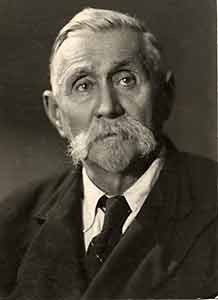
During student's years, he took a great interest in entomology. His trainer in this science was the outstanding entomologist N.A.Kholodkovsky, and his trainer on forestry - was the leading figure of Russian forestry science G.F. Morozov.
These prominent teachers predetermined a direction of scientific activity of Z.S. Golovyanko. This direction can be defined as the ecological approach to protection of a forest against pest insects. The approach is grounded on the idea that the role of these insects depends on the environment. In turn, the environment is formed largely by silviculturists. At proper forest cultural practices, the damage due to the insects is minimal one. Vice-versa, the the bad practices result in the situations, when the herbivorous insects bring damage to their host-plants.
After ending Institute, Z.S. Golovyanko during many years mated practical works in forestry units with scientific activity. His thesis "About steppe plantings in the 23 quarter of the Jekenlynskaya section" was written on the ground of stuffs collected within one year in the south of Ukraine in the Berdyansk standard forestry unit, where he worked as a helpmate of the forester.
Severe damage of forest stands planted in steppe by insect herbivores was acute problem in that time as well as that in present time. In his thesis, the thought was expressed that the destiny of forest stands in steppe conditions, i.e. at acute deficiency of humidity, depends on a number of practices, embracing soil treatment and planting, species compositions of the stands, and providing of their with specific structure. When these practices are proper, the damage due to pest insects gets minimal one, and longevity of forest stands in steppe is large.
Having maintaining of the thesis, Z.S. Golovyanko received the rank of a postgraduated forester of the first category that on its statute corresponded to the degree of a candidate of sciences maintained in a university.
The subsequent stage of activity Z.S. Golovyanko was connected with development of methods of establishing of pine stands in the conditions of high density of grubs - larvae of the cockchafer (Melolontha melolontha L., M. hippocastani F.), the European marmor = mottle scarab beetle (Polyphillo fullo L.) and related species of the order Coleoptera, the family Scarabaeidae - pests of tree roots. This was a living problem, because in many places in terrain of Russia, it took place the cases of mortality of young pine stands due to damagec of pine roots by these grubs.
Z.S. Golovyanko worked as helpmate of foresters in a number of places in Ukraine - present Kiev, Vinnitsa, Cherkass Regions and outside of Ukraine - in Voronezh, Urals (the Buzuluk pine forest), and Novgorod Regions. Having tasks as a practical employee to ensure satisfactory growth of pine stands, he under own initiative took a scientific activity developing of methods of establishing of pine stands resistant against the grubs in wide diversity of environmental conditions.
For this purpose, it was required to establish what kinds of factors were able to promote increasing of density of the grubs and capability of trees to resist them. His passion to science and unpretentiousness to household difficulties allowed to collect a rich stuff in the broad range of climatic and edaphic conditions, so that problem was successfully resolved.
He established, that density of cockchafer's grubs in the soil depended on temperature of this media. Therefore, in northern regions, their high density took place in stands with open canopy where the soil well became warm. Vice-versa, in southern areas, grubs preferred to populate in high density the stands with closed canopy, where the soil surface was less warmed.
These facts allowed to give the guidelines on limitation of grub density. In northern areas, it should to establish the stands with high stocking density, which needs to be decreased by thinning the in the age, when the trees are possible to protect themselves against the grubs. In southern regions, it needs to establish pine stands with lower stocking density.
Z.S. Golovyanko was by the pioneer in study of capacity of a pine to resist themselves against pests of their roots. It occurred to be that this capacity was provided by oleoresin exudation from wounds, which were inflicted by the grubs on roots. If oleoresin exudation was copious, the larvae terminated to damage the roots, and in some cases the grubs perished. This finding was reported in his publications of 1909, page 102, and 1949, page 7 (see list of the publications).
In the same publications, it was shown that determined capacity of a pine to resist the larvae. This was physiological state of the trees. If it was at a proper level, i.e. the tree was healthy, the oleoresin was exuded intensively. Weakened trees were disable to exude this product. Healthy trees are able to keep vitality at high density of grubs restoring affected roots.
The further development of these findings resulted in elaboration of ways to establish of the stands with a proper level of physiological state of the main stock of trees growing in these stands.
In short words, the idees are the following. It should take into account wide diversity of the concrete environmental conditions. Providing adequate supply the trees by moisture is the most important. If water regime of trees is satisfactory, they are able to exude oleoresin copiously, i.e. to protect themselves against grubs. Providing of the trees with nutrients is important also. Cultural practices, which need for securing of proper level of physiological state of trees, include appropriate soil treatment (deep ploughing, eradication of weeds), true choice of species composition of main and accompanied trees and brushes, usage of conditioned seedlings, and accurate planting of them, which excluded the twistling of rootlets.
He was one of the first scholars, who noted high resistance of the Crimean pine to pest insects in southern terrains (the Low-Dnieper sand area, the Kherson Region, Ukraine).
His practical activity occurred to be successful. He had a possibilty to watch the pine stand in age 43 years established under his guidance on the sites with high density of grubs.
The ways of establishing of pine stands with high resistance to grubs were described in a number of articles, in particular between 1911 and 1914.
Z.S. Golovyanko proposed recommendations as to protection of stands of deciduous tree species against grubs. The need in such protection arises often in gardens in initial years after planting of saplings. The transplantation from nurseries results in weakening of them. If the weakening is accompanied by high density of grubs in the soil, the saplings can perish. In roots of deciduous species, an operation of protective products to pest insects is expressed less than that in roots of coniferous species. But deciduous trees are capable to compensate well the damage by a regrowth of their roots. The regrowth is possible on condition that proper supply by moisture. Z.S. Golovyanko offered the watering of recently planted fruit trees as a measure of their protection. The watering should be used for protection of plant roots of any species from grubs, where it is possible.
Z.S. Golovyanko for the first time developed control measures against grubs. They were fumigations of the soil with preparations of paradichlorbenzole and polychlorides. These measures appeared to be very topical for protection of vineyards against grubs of the European marmor beetle on the Low-Dnieper sand area (the publication of 1927). In 1920-ies, the damage due to these grubs was very great. The same measures were used for protection of the sugar-beet against larvae of the cockchafer in different points of the region of cultivation of this crop (the publication 1928.). Later on he conducted tests on protection of pine seedlings against grubs by means of treatment their roots with insecticide BHC.
By following problem, in the solution by which Z.S. Golovyanko brought the fundamental contribution, there were factors of population dynamics of the bark beetles (Coleopera, Scolytidae). These studies were conducted on the Darnitskaya Forest Esperimental Station in the Kiev Region. Here Z.S. Golovyanko worked, since 1913. At the first, this was the Darnitskoye forestry unit, where he served as a forester, and since 1924 this forestry unit was reorganized into an experimental station.
Being a manager of the Station, Z.S. Golovyanko was successful to create the collective of employees, which became the outstanding specialists in forest entomology - A.I. Il'insky, N.S. Greze, V.L. Tsiopkalo, V.Yu. Parkhomenko, and M.A. Anfinnikov. The scientific level of this station was estimated as equal to that of an institute. This collective at participation of the practicing student - a probationer D.F.Rudnev initiated to solution actual for that time problem - protection of pine stands against bark beetle, which had became numerous. For this purpose, it was necessary to study the factors determining their population dynamics.
The outbreak of bark beetles in pine stands in the Forest-Steppe biome of Ukraine arose as a result of the drought of 1921 and economic ruin, which struck Ukraine during the Civil war and initial years after it.
It was established that the drought induced a decrease of the protective trait of trees - oleoresin exudation an area of conductive tissues - on stems and branches that enabled bark beetles to colonize these tree parts successfully, and to kill such trees. This phenomenon was established by an experimental way.
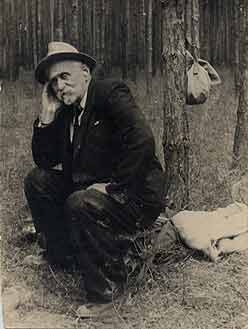
For conducting of the studies, Z.S. Golovyanko invited the plant physiologist E.F. Votchal and his assistants. They established the characteritics of capacity of trees to exude oleoresin (oleoresin exudation pressure) and factors, which influenced on values of it. The outcomes of the studies were submitted in the following publication: Votchal E.F., 1926. Studies on physiology of the oleoresin exudation apparatus of the pine, pp.53-58. In book: "Reports of the All-Union Congress of Botanists in January, 1926", Moscow. (in Russian).
In this study, it was used U-like glass tubes filled with mercury. One end of such a tube was inserted in bark of a pine stem until its sapwood. In an orifice of this tube's end, oleoresin came if oleoresin exudation was noticeable. The value of oleoresin exudation pressure was measured by a decrease of length of air column in the second (sealed) tube's end. The greatest oleoresin exudation pressure was recorded in a lower part of a pine stem where it exceeded atmospheric one on 2.5 atm. The value was influenced by a weather situation. In particular, drought decreased the pressure by far.
By this way, in first time over the world, it was stated the direct cause of decrease of resistance of the pine against bark beetles, in particular Ips sexdentatus Boern. This phenomenon is a cause of outbreaks of bark beetles, if the decrease of resistance spreads on the number of trees, which has become much more than the annual stem fall.
As regard this finding, Z.S. Golovyanko (1926, pp.77-78) has written: "Direct observations show that healthy, keeping strong oleoresin exudation pines successfully struggle for their existence pouring over boring beetles by oleoresin, sometimes even healing in due course the wounds."
Such a conclusion is of principal significance concerning the way of establishing of the forest resistant to bark beetles. Being necessary for resistance of trees to bark beetles, high oleoresin exudation pressure is provided by the proper level of their physiological state, in particular by optimal supply of the root system with moisture. This is possible on condition that adequite silvicultural practices, at which the trees grow being healthy.
There exists another view on the factors of tree resistance to bark beetles explaining this resistance by specific chemical composion of tree oleoresin. If this view would true, it should to select the trees with such a composition of their oleoresin and to use them in afforestation. The latter view has not won the recognition.
The concept developed Z.S. Golovyanko as to population dynamics of bark beetles might be expounded by the following scenario. Healthy trees are unaccessible for colonization by bark beetles, if amount of their populations has not increased comparing to customary one, which continually presents in undisturbed forest. A weakening of trees as a result of a drought, forest fire or other stresses allows bark beetles to colonize them, and to increase greatly the amount of their populations in the conditions of the vast food resource. After exhaust of this resource, i.e. weakened host-trees, the bark beetles are compelled to attack healthy trees. Such trees, as it has been pointed out, have capacity to give rebuff. To overcome the rebuff, the bark beetles need to attack them aggregating in the large numbers. Such mass attack allows bark beetles to smash the self-defence of such trees, but the consequences of the attack for brood of the colonized beetles are unfavorable. This is so because at high density of the colonization, the closed space under bark is unable to provide the brood with sufficient amount of food. Therefore, the majority of brood perishes, and survived insects have the reduced vitality. The latter leads to mortality of them under divers factors, mainly frost and pathogens. As a result of these phenomena, the amount of bark beetle populations returns to a value, which has been before an outbreak.
Importantly, it should not allow bark beetle populations to reach the outbreak level, because this leads to mortality of many healthy trees. The studies by Z.S. Golovyanko and his colleagues state that the due level of physiological state of trees is maintained by proper silvicultural practices. At an increase of the number of weakened trees in a result of emergency situations (strong drought), the expedient sanitary measures are demanded. These guidelines are topical until now, they will keep their value for ever. They are mirrored in the "Instruction for the foresters on bark beetles control in pine forests" (1927), drawn up by the collective of these scholars.
The collected stuff was treated mathematically. It was calculated the formulae, which allow to forecast a survival rate of bark beetles' brood depending on density of their colonization and effects of other factors. These studies, conducted in 1920-iås, are so perfect ones that they are amazing presently.
It is necessary to point out the contribution A.I. Il'insky, who advanced considerably the ideas of Z.S. Golovyanko about the factors of population dynamics of bark beetles on the wider stuff.
In 1960-1980-ies, in a number of countries, it was conducted extensive studies of factors of resistance of coniferous tree species against bark beetles, their pheromonal communication, and factors of population dynamics of these insects, as well as it was given evaluation of prospects of measures of forest protection against them. These studies confirmed validity of the conclusions offered by the scientific team under the guidance by Z.S. Golovyanko. In particular, the studies of bark beetles' pheromones revealed factors of the mass attack of host-trees by these insects, and other driving forces behind their populational behavior.
It has been developed the simpler means of registration of oleoresin exudation pressure and rate of oleoresin exudation. They allow to use widely this way of evalution of tree vitality in practice.
Z.S. Golovyanko made much for propagation of entomological knowledge in the media of silviculturists. First of all it is necessary to mention compiling by him of a guide-book for determining of species of grubs. The first edition of this book was issued in 1913. In 1936, the Academy of Sciences of USSR issued the amplate version of it. A number of his publications were dedicated to life history of Scarabaeidae beetles, natural enemies of them, and also protection of stands against pest insects of diverse species.
Since 1930, Z.S. Golovyanko holded a post of the manager by Department of Forest Protection in Ukrainian Research Institute of Agricultural Melioration and Forestry in Khar'kov, and since 1937 he was a manager by Faculty of Forest Entomology and Phytopathology of Kiev Institute of Forestry. By the solution of Qualifying Commission of All-Union Academy of Agricultural Sciences from April 9, 1936 was awarded with a degree of the Doctor of agricultural sciences without maintaining of a thesis. By the solution of Superior Certifying Commission at February 11, 1939 is approved in a rank of the Professor of forest entomology. Since November, 1936, he was the scientific employee of Institute of Entomology of Academy of Sciences of Ukrainian Soviet Socialistic Republic.
In 1930-1952-ies, activity of Z.S. Golovyanko was concentrated in the following directions: delivering of lectures, survey of state of forest stands concerning their pathology, developing of the concept of the effective depth of the soil as an important factor of forest existence, and publication of stored by him knowledge.
As a lecturer, he was a very talented man. He was skilful not only to notify knowledge, but also to carry away the students. He conducted the lectures and practical occupations with humour. The students liked him. They stored well amusing histories about him, and told those even in many years after his demise. Among his disciples, it was such outstanding forest entomologists as D.F. Rudnev, M.M. Padiy, and V.I. Grimal'sky.
The survey of state of forest stands, apparently, did not go into his straight lines of the official duties, at least in such grandiose scales as he did it. His purpose was to find out the causes of forest decline, and to give to silviculturists advances how to avoid it. He teached them that activity of insects was not à primary cause of the forest decline. Improper cultural practices, which predetermined weakening of trees served, as the primary cause of these phenomenon. The weakening led to affection of them by insects. This affection was most severe at weather situation unfavorable for trees. The improper cultural practices were miscellaneous. He revealed the errors in concrete cases and articulated them to silviculturists, so that "good silviculture" promised healthy and high productive forest, whereas damage due to insects would be insignificant.
This approach to forest protection from pest organisms is very topical in the present time. His recommendations were based, firstly, on profound knowledge of literature in forestry and entomology. In these sciences, our country was among the world leaders. In addition, he brought large personal contribution in the knowledge.
He surveyed nearly all the pine forests in the Central and East Ukraine. His energy in this respect did not know a limit. So, in 1951 in the age of 74 years, he surveyed 19 forestry units, i.e. many thousand hectares of the Ukranian forest, located in different Regions.
What to do, if an value of the effective depth of the soil was insufficient for successful growth of a forest, was the last scientific problem, which was undertaken to decide by Z.S. Golovyanko.
The value of the effective depth of the soil is a distance, on which roots of trees are capable to be spread. This distance is determined by a depth, where the subsoil layer unpenetrable for the roots, is situated. Within the limits of growing of the pine on Ukraine, this unpenetrable for a pine roots layer is usually a permanently dry sand. The negative role shallow effective depth of the soil is expressed especially in the Steppe biome and everywhere at drought. The more effective depth of the soil, the better conditions of growth of forest. The problems consist in finding of the measures, which allow trees to tolerate shallow effective depth of the soil and how to provide penetration of the pine roots lower through the obstacle, where it is situated again the layer wetting by the subsoil water table.
Digging out root systems in diverse conditions, Z.S. Golovyanko revealed that pine roots in some circumstances were able to penetrate through the interruption to the wet layer. In fact, he established, that poplar's roots spread more deeply in the dry sandy layer than pine's roots do. Probably poplar trees were able to moisten the dry soil layer pushing forward to the situated deeply continually wet layer (in spring or in other seasons at abundant rains). If in place of cut down poplar trees to plant the pine trees, their roots would used the poplar roots penetrating along them into the wet layer of the subsoil. These findings allowed Z.S. Golovyanko to give the guidelines to melioration of severe environmental conditions by means of preliminary planting the poplars, and after of cutting of them by planting of the pines. These practices are prospective in relatively favorable growth conditions for the pine - in the sandy soils on a flat terrain on the Forest and Forest-Steppe biomes.
He studied growth of the Crimean pine and its resistance to pest insects. This tree species occurred to be more tolerable to deficiency of moisture in the soil. Usage of this species for afforestation largely removed a problem the insufficient effective depth of the soil.
Therefore, the Crimean pine is especially prospective for southern regions, in particular the Low-Dnieper sandy area (the Kherson Region, Ukraine). In such conditions, the Crimean pine is resistant to any stressors and high productive.
The list of publication by Z.S. Golovyanko includes 62 items. Last years of life he managed to publish two monographies, that demanded of huge efforts. One of them was the mentioned above book about the causes of decline of pine stands (1949), and the second one was about the European marmor (July) beetle, Polyphillo fullo L. as a pest of forest, grape and garden cultures (1951). The book "Dependence of resistance of the pine against a drought on amount of the effective depth of the soil" with a volume of 261 type-written pages finished in 1951, has remained unpublished. New wording of the guide-book for determination of scarab larvae with fine figures and several articles about the Crimean pine were not published.
Z.S. Golovyanko as the person can be described by following words: raising of the high purposes, persistence in their achievement, high moral principles, vigorous energy in ministering to science and culture.
Being a poor man by birth, he went from Ukraine to enter in the Petersburg Forest Institute almost without money, and fasted until began to receive a small student's manual. Nevertheless, he found in himself forces to take a great interest in science, and paid on himself attention of such outstanding specialists as N.A. Cholodkovsky and G.F. Morozov.
As an illustration of a respect of G.F. Morozov to Z.S. Golovyanko, it can serve the dedication of the book by Henrich Heine gifted by G.F. Morozov: "Among treasures of your spiritual world, you should find the abutments for quieter, philosophical attitude to the ambient ordinary. You should take care himself, instead of to work in vain. You need in the joy of life similar to that, which may be given to you by this book of the beloved by you poet. To dear Zinoviy Stepanovich from loving you and feeling about you. G. Morozov." 27.VIII.1918.
This book had been written in German with the Gothic print. These scholars were highly educated people.
Z.S. Golovyanko was a friend of the largest specialist on steppe afforestation - G. N. Vissotsky that, however, did not hinder them to argue bitter on forest subjects. Z.S. Golovyanko said about a legend of their interrelations. As if, when the verbal arguments were unable to straighten out the true, they passed to a hand-to-hand duel. However, the publications of G. N. Vissotsky gifted by this scholar with a signature: "To dear comrade Zinoviy Stepanovich", which are kept in the library of Z.S. Golovyanko, contradic this legend.
A number of facts testifies to his moral level. For example, in 1905, being a forester in the Novgorod province, he refused to participate in supression of peasant disorders. A consequence of the refuse was that until the October revolution, he had not an access to scientific positions. He was engaged in science under own initiative, working as a practicing silviculturist in foresrty units. It appears, in that time there was a discrimination on political grounds also.
In the Soviet time, he did not do any attempts to enter in the Communist party, though his social origin did not handicap with this.
During The Great Patriotic War, he had no a capacity to be evacuated from Kiev being affected with the cancer. Remaining on the occupied terrain, he was compelled to serve under occupation authorities to die not from famine together with his family. However, he reduced to minimal a level of cooperation with the Nazi occupanists, remaining on the minor position, and evading from higher one. This behavior was considered by the authorities as a kind of sabotage, and their attitude to him was boorish. He worked in Kiev's Institute of Zoology, where entomologist K. Schedl was a director.
During difficult years of the Nazi occupation, his flat served as a hiding place for the numerous people. After the liberation of Kiev by the Soviet army, he had no any reclamations. He was aworded by the medal of USSR Goverment "For Heroic Labor During the Great Patriotic War" with the portraite of Generalissimo Stalin.
The desire of Z.S. Golovyanko to shore people, who were exposed the breaches of justice, occurred to be a heavy burden for him. This event took place in the period, when in USSR on all the institutions bound with biology, the authorities implanted the "forward Michurin's biology". So, it was called by the official propagation the quackery, which Academician T.D. Lysenko and his sponders pronounced by a last achievement of science, whereas the classic genetics was stigmated as a reactionary doctrine hostile to the Soviet people. Of course, this campaign was organized by an instruction of the first person of the State. Under the secret order of authorities, in each biological institution, it was necessary to reveal scheduled number of persons, who should be declared as the supporters of the hostile doctrine, and to subject them by reprisals. The selection of victims was conducted with a insidious resourcefulness. It was declared that it was conducting the discussion of problems in "biological science", and each member of a collective was offered to express his judgement on a general meeting.
In educational institutes, the primary victims were obvious. They were the specialists, which delivered a course of genetics. But it was not enough of them to execute the schedule as to the number of detected "reactionaries." The fulfilment of the schedule was reached at the expense of those, who had imprudence to talk in defence of the victums. Among such suckers, Z.S. Golovyanko certainly occurred.
Having heard on a meeting in the Kiev Forestry Institute that the persons delivering of genetics were angrily criticized, he appealed with the proposal to not condemn them so unconditionally. That was enough to select him for addition to a list, which was needed for fulfilment of the planned number of the victims, though the course of his lectures had no relation to genetics.
The persecutions consisted in removing him from the duty of management by the Faculty of Entomology, and he was deprived the professor's ranks. The latter afflicted him very much. This man 73 years old cried. But then facilitation was set. He addressed with the petition to N.S. Khrushchev- in that time the First Secretary of Central Commitee of Comunist Party of Ukraine. A rank of the professor was returned to him.
The last months of life, being for a long time lying ill, he did not terminate scientific activity - gave consultings to the students and post-graduate students.
Being engaged intensively in delivering of lectures and exploratory activity on his speciality, he found time for work on by problems the ancient Russian literature. In particular, he performed the articles and offered oral reports before the specialists explananing of vague places of the ancient poem "The Word about an Army of Igor." He salvaged for mankind many valuable books and pictures, collecting and saving them when people had no a capacity to evaluate their value.
His personal privacy occurred to be deeply tragic. He lost three sons died due to illnesses. He outlived his wife - Lidia Antonovna. He deeply suffered affliction from those horrors, which fall upon our people in ÕÕ century. He found forces to go through all these torments. He married in the second time in the age of 60 years. His second wife Elena Epifanovna remained of his valid friend up to the end of his days. With him were the daughter Natalia and the grandson Gleb.
Z.S. Golovyanko has deceased on September 23, 1953.
The life of this man of faith of science and a bright person can be an example for us.
The main publications of Z.S. Golovyanko
1. Development of a root system and its state as a condition of successful development of the pine. Trudy po Lesnomu Opytnomu Delu Rossii (Studies of Forest Science in Russia), 1909. V. ÕÕI, St.-Petersburg, 56-140. (in Russian).
2. On the issue of control measures with grubs, 1911. Lesnoy Zhurnal (The Forest Journal). (in Russian).
3. On the Problem of Silvicultural Measures of Grub Control, 1914, Kiev. (in Russian).
4. Golovyanko Z.S., 1926. On Methods of Survey of Colonization of Pines by Bark Beetles. Trudy po Lesnomu Opytnomu Delu Ukrainy (Studies of Forest Science in Ukraine), Kiev, 87 pp. (in Russian).
5. An Instruction for Foresters as to Control of Bark Beetles in Pine Forests, 1927. All-Ukrainian Management by Forests, Kyiv, 8 pp., 15 figures (the co-authors M.S. Greze, A.G. Ill'isky, L.F. Rudnyev, V.I. Parkhomenko, V.L. Tsiopkalo) (in Ukrainian).
6. Paradichlorbenzole in Control of Larvae of the Marble beetle in Vineyards in the Low-Dnieper Sandy Area, 1927. Kiev. (n Russian).
7. The practice of application of Paradichlorbenzole in control of cockchafer larvae on plantations of the sugar-beet, 1928. Collected articles of Suger Station of Ukraine. (in Russian).
8. The Guide-Book for Determination of Most Common Larvae of Lamellicornia (Coleoptera) beetles of the European Part of USSR, 1936. Academy of Science of USSR Publ., Moscow - Leningrad, 38 pp., 70 fig. (in Russian).
9. Cause of Decline of Pine Stands, 1949. Academy of Science of Ukrainian SSR Publ., Kiev, 43 pp. (in Russian).
10. The Marble Beetle as a Pest of Forest, Grape and Garden cultures on the Sandy Soils, 1951. Academy of Science of Ukrainian SSR Publ., Kiev, 147 pp. (in Russian).
11. Dependence of Resistance of the Pine against Drought on the Effective Depth of the Soil, 1951à. 261 pp. (Unpublished, in Russian).